i6204

i6204

Eswatini’s Strategic Oil Reserve leaks over E100 million Inhlase on December 5, 2025 at 8:07 am

BY INHLASE REPORTER

Over E100 million of taxpayer’s monies meant for the development of the country’s strategic oil reserve cannot be accounted for. Between 2016 and 2025, over E100 million meant for the foundational design phase was spent with no works done.

The Strategic Oil Reserve facility at Phuzumoya in Siphofaneni is an initiative meant to be the nation’s bulwark against fuel scarcity and price volatility, guaranteeing a crucial 60-day supply. The project’s groundbreaking ceremony was presided over by His Majesty King Mswati III on the 23rd of April 2025. The Taiwanese Minister of Foreign Affairs, Lin Chia-lung, was also in attendance.

An Inhlase investigation reveals a catalogue of financial mismanagement and procurement malpractices that saw over E100 millions of taxpayers’ money squandered on failed designs and ill-conceived contracts long before the recent E5.2 billion agreement for its construction was signed.

Audits reports show that in 2016, the Ministry of Natural Resources and Energy (MNRE) paid multiple companies E93 325 261.61 for foundational and design work.

Phase 1: Initial Infrastructure and Designs (2016–2019)

The MNRE’s first major expenditure related to the project involved four different companies between 2016 and 2021, totalling E57 726 656.66. 

The recipients included:

Inyatsi Construction (Pty) Ltd: Received E47 444 273.28 for road construction activities between 2017 and 2019.

Eswatini National Petroleum Company (ENPC): Received E10 000 000 in 2021.

Eswatini Electricity Company (EEC): Received E188 077.02 for electricity services in 2016.

Mpendza Construction (Pty) Ltd: Received E94 306.36 for other professional services in 2017 and 2018.

This initial outlay suggests significant preparatory work, but the most egregious spending was yet to come on the actual technical designs. In short, the companies were paid without full delivering the work while others were paid without having their work available since their work depended on the completion of the designs. Basically, the controlling officer at the time in the MNRE as well as the then project lead and the Ministry of Finance paid for services that were not fully or not rendered at all.

Phase 2: The CTCI Corporation Contract (2018–2021)

On October 25, 2018, the MNRE engaged the Taiwanese firm, CTCI Corporation, for Basic Design Engineering Services and Engineering, Procurement, and Construction (EPC), at cost estimate. The contract, signed in February 2019, aimed for basic project designs and detailed estimated costs for the four 10 000 cubic metres oil tanks.

Despite the scope being limited to basic designs, the MNRE paid CTCI Corporation E35 598 604.95 over three years (2019 to 2021). This payment was for initial deliverables like the plot plan and process flow diagram.

The ENPC Era: From ‘Optimisation’ to Irregular Expenditure (2021–2024)

In 2020, the project was transferred to the newly established ENPC under the Petroleum Act, No. 16 of 2020. Despite inheriting a project that had already consumed over E93 million, the ENPC Board resolved in December 2020 to re-cost the designs and procure a new contractor for “Design Optimisation and Bills of Quantities Consultancy Services.”

This decision essentially rendered the E35.6 million paid to CTCI Corporation for the original designs worthless. The ENPC’s subsequent actions only compounded the financial disaster. Further, it showed that there was no proper handover of the project from the ministry to ENPC resulting to a lot of fruitless expenditure.

The Billion Brother/Fhatani JV Fiasco (2022–2023)

The tender for design optimisation was awarded to a purported Joint Venture (JV) between Billion Brother Project Management Consultancy (Pty) Ltd and Fhatani Consulting Engineers. The audit revealed the JV was non-existing as there were no signed documents, lacking formal registration—a fundamental breach of due diligence that deprived other bidders of an opportunity. By standards, there should be an agreement of the JV and formal registration locally to be deemed lawful.

Original Contract and Unauthorised Scope Change: 

The original contract, dated May 9, 2022, was for E9 995 574.22. However, the scope of work was changed to essentially reproduce the designs from scratch, despite the MNRE having already paid E35.6 million for them.

Inhlase can reveal that there was an unjustified cost escalation in this contract. An Addendum dated August 31, 2022, increased the contract price by nearly 90% (E8 995 469.70), hiking the total contract value to E18 991 043.92. Documents seen by Inhlase reveal that the Eswatini Public Procurement Regulatory Agency (ESPPRRA) warned against this, advising an independent evaluation due to the high value, but ENPC ignored the advice and appealed the position. Furthermore, the former CEO is said to have failed to seek the minister’s approval for this significant change and cost escalation, violating Section 51 of the Public Finance Management Act which reads “Public officers with financial responsibility must seek the Minister’s approval for any cost escalations, deviations, or changes in project scope that might contravene the law.”

This was deemed a fictitious contract and fraudulent payments. The contract was deemed “fictitious” by the auditors, lacking key protective clauses like penalties for non-performance or delays. Despite the contract being terminated on October 10, 2023, due to “unsatisfactory and/or incomplete” work, ENPC had already paid the JV E16 082 204.05 which was a colossal figure representing fruitless and wasteful expenditure for services not rendered. The auditors further noted irregular payments, including E1 080 834.64 paid to Billion Brother for “Deloitte – Financial Model” and “Deloitte – Feasibility Study,” suggesting the JV may have been a “conduit pipe” for funnelling funds to Deloitte and Touche South Africa without a direct agreement.

“Regulation 113 (5) of the Public Procurement Regulations of 2020 clearly stipulates that, for a Contract Amendment to be valid, it must be duly signed by the authorized representatives of both the procuring Entity and the Supplier.”

The ESPPRA is a body in the country, established according to under the Procurement Act of 2011 has the power to regulate procurement in Public Enterprises and Local Governments. The board also has powers to investigate suppliers and blacklist them. When the ESPPRA Chief Executive Officer Vusi Matsebula explained that they were not made aware if the ENPC declined any advice from the entities.

“As to whether they have disregarded our advice we have not been made aware of that,” he said.

Understanding that there is a recently completed forensic audit of ENPC, Matsebula said the ENPC would need to communicate to them on issues of procurement that would require the ESPPRA’s intervention.

The Deloitte, EPCM/SOLIDCARE, and Buna Group Irregularities (2023)

The financial misconduct escalated as ENPC engaged three separate entities for overlapping or redundant services, repeatedly flouting tender procedures. Documents that the publication saw, from the ESPPRA indicate that in a number of instances the regulatory board warned about the floated procedures. 

ENPC awarded Deloitte & Touche South Africa Tender No.7 of 2023/2024 for the provision of consultancy services for finance raising, development and technical advisory services for the construction of the strategic bulk fuel storage. Deloitte and Touche came with other companies, EPCM JV, a consortium between Solid Care Services (Pty) Limited and EPCM Bonisana (Pty) Technical Consultants. However, they failed to deliver the awarded and agreed-upon. Despite the failure, ENPC paid Deloitte retainer fees amounting to E5 172 400 which is deemed as another instance of fruitless and wasteful expenditure.

EPCM/SOLIDCARE JV: Engaged on September 1, 2023, for technical advisory services without adhering to procurement processes.

The initial contract price was E16 700 000, but the technical advisory component in the tender proposal was only E11 250 000, meaning there was an unjustified increase of E5 450 000 in the final contract.

Payments to this JV totalled an astonishing E31 167 197.10. Crucially, E29 500 530.43 of this total was deemed irregular expenditure, as it was incurred for services not covered in the original scope, but unlawfully introduced through Addendums instead of new Requests for Proposals (RFPs). 

Buna Developers (Pty) Ltd: Engaged on December 17, 2023, for development advisory services, again without adhering to procurement processes. This was for the same scope of services already awarded to Deloitte and Touche.

The original contract of E7 393 500 was later increased by E2 406 500 to E9 800 000 via an Addendum, again lacking justification for the price hike. Total expenditure on advisory services to the Buna Group was E12 006 451.25.

The newly appointed ENPC Board Chairperson Dr Velaphi Dlamini was engaged to clarify the steps that have been taken by the board. 

“We are in possession of information indicating that the Auditor General’s report has flagged the flouting of procurement procedures involving Billion Brothers, Deloitte & Touche, and Buna Developers.

Asked about the remedial action, he said: “Kindly note that we confirm that as the Board we have received a report as you have stated. Please note we are in the process of consulting and engaging with all relevant stakeholders in respect of the findings in the report.”

The Grand Total: Over E140 million down the drain

The investigation paints a grim picture of a national project mired in incompetence and corruption, where poor planning and reckless financial practices cost the public an immense sum before the current construction phase.

The total funds paid out to these companies for designs, optimisation, and advisory services that were either rejected, incomplete, or fraudulently inflated, amounts to a stunning E157 753 114.01 excluding the recent E5.2 billion contract with Overseas Electric and Engineering Corporation.

The investigation revealed that the project suffered from insufficient oversight and technical expertise which failed to ensure that the processes delivered tangible results commensurate with the funds expended. 

Based on the funds that were commissioned at the MNRE prior to the formation of ENPC, it shows a lack planning and accountability. A visit to the site among the paid for services which is over E47 million for a road to the site, when the project was at the MNRE, showed that there had been a gravel road to the site. Additionally, a lack of oversight from Parliament can be pinpointed in this regard as funds had been allocated to the ministry for the project on a yearly basis without scrutinising the amount of work covered by previous budgets.

Despite all the funds that have been channelled by ENPC Board and former CEO, in September 2023, ENPC entered into a Memorandum of Understanding (MOU) with the Overseas Investment and Development Corporation (OIDC), the parent company of Overseas Electric and Engineering Corporation (OEE). By April 2025, a contract was signed with OEE for the bulk of the construction works, valued at USD290 000 000 (plus a USD3 000 000 provisional sum), an amount equivalent to approximately E5.2 billion at current exchange rates.

The audit noted the tragic irony: the initial investment on drawings, followed by the substantial payment for the “optimisation” process that produced no tangible deliverables, meant a fresh contract was required to commence the project, essentially paying for the same item designs all over again.

The dream of a 60-day strategic fuel reserve, a necessity underscored by the 2021 civil unrest and subsequent supply challenges remains alive. But Eswatini’s energy security comes at a devastating cost, not just the E5.2 billion construction price, but the E157 million already lost to poor governance, procurement breaches, and sheer waste. The public demands accountability for the millions that simply vanished.

In June 2025, Eswatini’s Parliament passed a Finance Bill that granted the Minister of Finance and ENPC permission to engage OEE, which is the Taiwanese company that will do the job at E5.2 billion. The passing of the Bill came against a backdrop of a controversy regarding the existence of another Botswana-based company which had presented to conduct the same job for E2.8 billion. Surprisingly, since the news about the engagement of the Taiwanese company started making rounds, early 2024, Members of Parliament (MPs) vowed that the E5.2 billion contract would not see the light of the day in Parliament. 

During a workshop of the House of Assembly and Senate Portfolio Committees at Pigg’s Peak Hotel around November 2024, the former CEO told Parliamentarians that there was a company that brought almost similar or better designs for the project for E2.8 billion. Last December, the government through the MNRE sent a delegation to finalise the deal in Taiwan, which was led by Minister Sikhumbuzo Dlamini, the incumbent Minister of Tinkhundla Administration and Development, who represented the MNRE Minister Prince Lonkhokhela.

In April 2025, the Minister of Finance, Neal Rijkenberg, tabled the Strategic Oil Reserve Loan Bill with a certificate of urgency. In May 2025 during a workshop of the loan Bill, the House of Assembly Finance and MNRE portfolio committees, started singing a new tune showing their full support to the Bill and the E5.2 billion facility. Notably, the workshop occurred weeks after the Republic of China on Taiwan Minister of Foreign Affairs Dr. Lin Chia-lung visited the country where an unavailing of the oil reserve 3-D architectural model was made before His Majesty King Mswati III at Mandvulo Grand Hall. On May 29, 2025, the House of Assembly passed the Bill.

Just a month ago, the MNRE Minister took the chairpersons of both Houses of Parliament to tour the construction site. He expressed gratitude at seeing the progress of the project and explained that it is expected to be completed within 36 months. 

In terms of the unjustified expenditures, the minister explained that the office of the Auditor General has been engaged but could not comment on whether the audit has been implemented or would be implemented. The minister assumed his position in 2023. In 2024, he dissolved the ENPC Board before the end of its term, which was appointed in 2021. Further, the then CEO’s contract was not renewed.

A breakdown of some of the funds

Period Service Provider Service Description Amount (E) Status
MNRE ERA (2016-2021) CTCI Corporation Basic Design Services E35,598,604.95 Fruitless & Wasteful
MNRE ERA (2016-2021) Inyatsi, EEC, Mpendza, ENPC Initial Infrastructure & Funds E57,726,656.66 Wasteful Expenditure
ENPC ERA (2022-2023) Billion Brother/Fhatani JV Design Optimisation E16 082 204.05 Fruitless & Wasteful
ENPC ERA (2023) Deloitte & Touche Finance Raising Advisory E5 172 400 Fruitless & Wasteful
ENPC ERA (2023) EPCM/SOLIDCARE JV Technical Advisory (Irregular) E31 167 197.10 Irregular Expenditure
ENPC ERA (2023) Buna Group Development Advisory E12 006 451.25 Unjustified Expenditure
SUB-TOTAL E157 753 114.01

​Inhlase  

BY INHLASE REPORTER Over E100 million of taxpayer’s monies meant for the development of the country’s strategic oil reserve cannot be accounted for. Between 2016 and 2025, over E100 million meant for the foundational design phase was spent with no works done. The Strategic Oil Reserve facility at Phuzumoya in Siphofaneni is an initiative meant

Zambia’s Young Gymnasts are Rising! Editor on December 3, 2025 at 2:07 pm

By Brenda Muzeya

Zambia’s young gymnasts continue to make remarkable strides, with fresh talent emerging from the Bliss Gymnastics and Arts Zambia Academy following an energetic inter-district competition between Lusaka and Ndola. The event highlighted the sport’s rapid growth and the nation’s rising prospects on the international scene.

Coach Siphongile Kasaro expressed gratitude to parents for their support and noted the academy’s impressive progress since its establishment.

“Gymnastics is growing extremely well, and we are impressed with the performances,” Kasaro told MakanDay.

The Lusaka–Ndola competition marked a major step for the sport locally, giving athletes a platform to showcase their skills. Kasaro hopes that more districts will now join in, especially ahead of Zambia hosting an international gymnastics competition in July 2026.

“We will ensure other districts across the country take part in the regional event,” she said, emphasising the need for more qualified coaches. The academy plans to expand into Eastern and Northwestern Provinces, where it hopes to train local coaches and strengthen the sport nationwide.

Zambia’s young gymnasts have already proved their potential, winning gold and silver medals at the African Youth Development Championship in Harare, Zimbabwe, a breakthrough that has pushed Zambia firmly onto the global gymnastics map.

Kasaro appealed for sponsorship to ensure that talented girls from low-income households are not left behind.

“We offer sponsorship to those who cannot afford, because we want their talent to shine,” she said.

Among the young stars is nine-year-old Diana Daka, who claimed her first medal at the competition. Beaming with pride, she said she is determined to work harder ahead of the next regional event. Her mother, Diana Kasaro, praised the academy’s support and encouraged other parents to enrol their daughters.

The upcoming regional competition in Zambia is expected to draw teams from Zimbabwe, Cameroon, Namibia, and Mozambique, setting the stage for one of the country’s most exciting gymnastics events yet.

Zambia’s National Gymnastics Team Heads to the Region Five Games

Zambia’s national gymnastics team will compete at the Region 5 Games in Windhoek, Namibia, on 11 December 2025. The team features exceptionally talented young athletes:

Level Seven
  • Chimwemwe Namwila (12)
  • Zion Britton (12)
  • Anisha Katanga (14)
Level Five
  • H’leziphe Mbale (11)
  • Lushomo Mwango (12)
  • Bella Mudenda (10)
  • Paris Malawo (10)
Brenda is an intern at MakanDay under the Free Press Initiative’s Journalism Graduate Internship Programme, which aims to promote excellence in journalism.

By Brenda Muzeya Zambia’s young gymnasts continue to make remarkable strides, with fresh talent emerging from the Bliss Gymnastics and Arts Zambia Academy following an energetic inter-district competition between Lusaka and Ndola. The event highlighted the sport’s rapid growth and the nation’s rising prospects on the international scene. Coach Siphongile Kasaro expressed gratitude to parents Latest News – MAKANDAY 

By Brenda Muzeya Zambia’s young gymnasts continue to make remarkable strides, with fresh talent emerging from the Bliss Gymnastics and Arts Zambia Academy following an energetic inter-district competition between Lusaka and Ndola. The event highlighted the sport’s rapid growth and the nation’s rising prospects on the international scene. Coach Siphongile Kasaro expressed gratitude to parents

Mining Firm Secures Licence to Dig in Protected Area Editor on December 3, 2025 at 6:10 am

By Ronny Mukontwa

Documents reveal that the government has approved large-scale mineral exploration inside the Mukungule Game Management Area (GMA), a protected wildlife corridor — despite repeated assurances from officials that mining cannot take place in environmentally sensitive zones.

Many residents first heard rumours of a mining company entering the GMA but dismissed them as gossip. That changed when documents surfaced showing that government agencies had quietly signed off on the project.

Questionable consent and limited community awareness

A consent letter, allegedly signed by the Mukungule Community Resource Board (CRB), claims the community approved Unicorn Resources Limited’s exploration licence. But this approval is now in dispute, with critics arguing that the process may violate Section 91(1) of the Environmental Management Act (2011), which guarantees public participation in environmental decision-making.

The letter—purportedly co-signed by CRB coordinator Elias Bwalya and Chairperson Leward Chilufya—states that the board unanimously allowed Unicorn to explore for lead, copper, quartz, emerald, iron ore, cobalt, silver, and gold under licence No. 31012-HQ-LEL.

“Having Perused through the Licence Copy Ministry of Mines, Pegging Certificate of Ministry of Mines, Chief Consent and Company PACRA documents which company availed during the Mukugule Joint CRB Meeting in the presence of all the board members. The Board (CRB) is satisfied to let the company proceed with exploration activities in the licence no 31012-HQLEL in Mukungule Chiefdom,” reads part of the letter

Yet, interviews with residents from Mukungule Market, Chobela – the place where the project is located, and Katibunga revealed that most had never heard of the project. Even WeForest Zambia, a conservation organisation operating in the area, said it was not informed.

A CRB member speaking anonymously alleged that the board approved the project after the chief instructed them to do so during a meeting on 24 January 2024. Efforts to get comment from Chief Mukungule were unsuccessful.

A handwritten “prospecting letter” dated 28 September 2023, however, shows the chief only authorised Unicorn to search for known minerals in the Chobela area—and required the company to report back if minerals were found.

Mukungule GMA borders the North Luangwa National Park and is home to elephants, zebras, hippos, and lions. As a wildlife corridor, it is jointly managed by the Department of National Parks and Wildlife (DNPW) and the CRB.

Who owns Unicorn Resources?

The Patents and Company Registration Agency (PACRA) records show Unicorn Resources Limited is predominantly foreign-owned. Dubai-based Natraj General Trading FZE holds 75,000 shares—giving it effective control.

Indian nationals Sharad Goel and Nitin Kumar Yadav, together with Zambians Kalasa Chibwe and Sheban Mutesu, hold the remaining shares. Goel is listed as the only beneficial owner, underscoring the company’s concentrated ownership and strong foreign influence.

The company’s exploration licence allows for road clearing, drilling, and the establishment of exploration camps.

Environmental approval despite risks

An Environmental Project Brief (EPB) approved by the Zambia Environmental Management Agency (ZEMA) identifies risks such as deforestation, noise, pollution, and loss of wildlife habitats.

In a decision letter signed by acting Director General Karen Banda Etondo, ZEMA said the project was approved after considering submissions from affected parties and site inspections. The approval came “with conditions,” but those conditions appear inconsistent across government agencies.

Government contradictions and evasive responses

Unicorn Resources declined to explain how it obtained authorisation to operate in a GMA, with director Sharad Goel instead questioning the reporter’s sources.

At the Ministry of Mines, Permanent Secretary Dr. Hapenga Kabeta insisted that mining in ecologically sensitive areas is prohibited and rejected suggestions that government is prioritising mining over conservation.

“No, no, no! That’s why the licence for the mining project in the Lower Zambezi National Park was cancelled,” Kabeta said.

Wildlife authority warns of habitat destruction

The Department of National Parks and Wildlife (DNPW) admitted that the Unicorn project will fragment animal habitats, displace wildlife, and increase human–wildlife conflict.

DNPW Director Dominic Chiinda said the department approved the project only under strict conditions: limiting operations to handheld tools, banning waste disposal in the GMA, and requiring a Wildlife Police Officer to be stationed on-site at the company’s expense.

However, ZEMA’s approval letter contradicts DNPW’s conditions, allowing heavy machinery such as truck-mounted reverse circulation drills and diamond drilling rigs.

Growing Fears in Local Communities

The project has sparked anxiety among residents living inside the GMA.

“I have lived here for 15 years. What will happen when they discover minerals?” asked 49-year-old widow Judith Musonda, sitting outside her grass-thatched hut.

Others, like 30-year-old father of three Sylvester Tembo, worry about displacement and poor accountability within the CRB.

“We’ve heard stories of people waiting years for compensation, and even then, it’s not fair,” he said.

WeForest Zambia’s Mukungule project manager, Rachel Ndabala, warned that mining could heighten human–elephant conflict and disrupt migration corridors.

ZEMA has instructed Unicorn to avoid indiscriminate tree cutting, replant cleared areas, and protect water bodies from contamination — but residents doubt these safeguards will be enforced.

Ronny is a fellow under the Wildlife Crime Prevention (WCP) environmental fellowship for journalists.


The MakanDay Centre for Investigative Journalism, in partnership with WCP, supported the reporting of this story.

By Ronny Mukontwa Documents reveal that the government has approved large-scale mineral exploration inside the Mukungule Game Management Area (GMA), a protected wildlife corridor — despite repeated assurances from officials that mining cannot take place in environmentally sensitive zones. Many residents first heard rumours of a mining company entering the GMA but dismissed them as Latest News – MAKANDAY 

By Ronny Mukontwa Documents reveal that the government has approved large-scale mineral exploration inside the Mukungule Game Management Area (GMA), a protected wildlife corridor — despite repeated assurances from officials that mining cannot take place in environmentally sensitive zones. Many residents first heard rumours of a mining company entering the GMA but dismissed them as

Black Gold, Lost Childhoods Editor on December 1, 2025 at 9:02 am

How Poverty is Fueling Child Labour in Monze’s Charcoal Trade

By Emily Kuwema

Before sunrise, 14-year-old Alfred Habwaya* disappears into the thinning woodland of Chona Chiefdom in Monze district. His school uniform lies folded in an old bag, replaced by a sack and a machete. Each morning, he joins older men and women in feeding smouldering earth kilns that turn trees into charcoal, black gold in a community running out of options.

“I wanted to stay in school, but we sleep hungry if I don’t help make charcoal,” he says, his palms blackened with soot.

Across Southern Province, hundreds of children like Habwaya have quietly joined Zambia’s booming but illegal charcoal trade. What was once a side hustle for rural families has become a full-time lifeline, one that is devastating forests, derailing education, and defying the country’s own child labour laws.

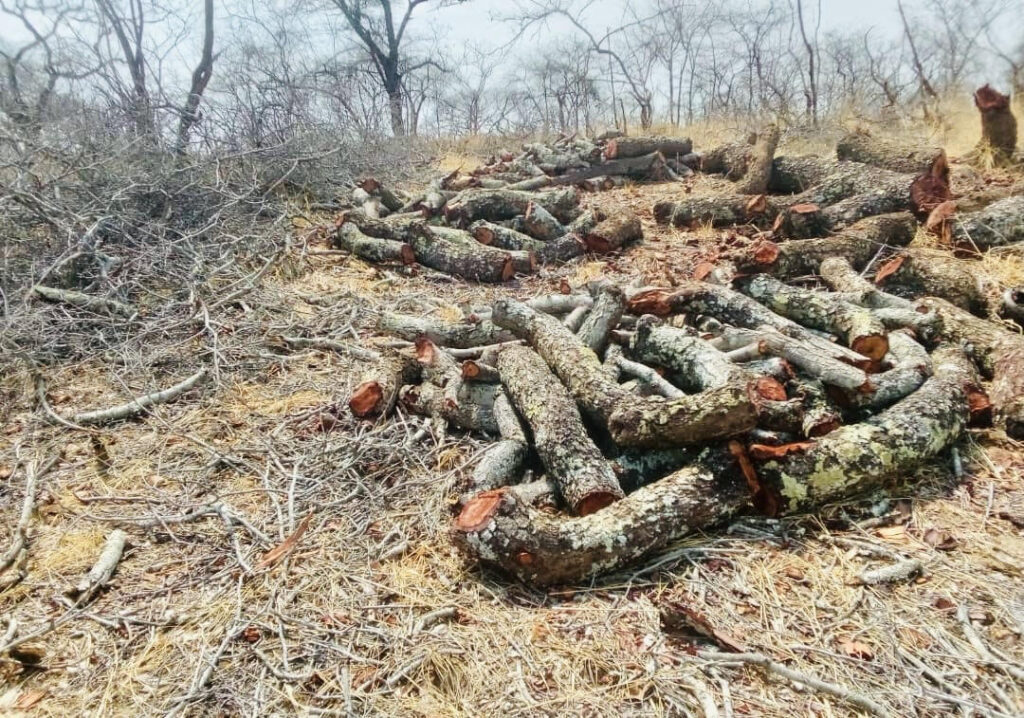
Uncollected logs lie in Monze’s Chona area await collection for charcoal production. Picture by EMILY KUWEMA

An investigation by the Times of Zambia in Chona Chiefdom reveals a growing crisis. As drought and poverty tighten their grip, children are being pulled out of classrooms to keep households alive. Despite government policies banning hazardous child labour and millions channelled through Constituency Development Fund (CDF) projects to support alternative livelihoods, little has changed.

Despite repeated government pledges to end child labour and promote sustainable energy, oversight in Monze remains weak. Local officials admit that CDF funds meant to support alternative livelihoods have not reached most rural households, while the Forestry Department says it lacks resources to monitor illegal logging and charcoal production.

The road to Chona Chiefdom is lined with scorched patches of land.

Interviews with local leaders, forestry officers, and residents reveal that charcoal production, driven by poverty and limited livelihood options, continues to expand, fuelling deforestation and rising school dropouts.

Chief Choongo of the Tonga-speaking people can hardly hide his frustration.

“We have spoken about the effects of cutting trees, but the message has not been heard in some areas,” he says. “Children are suffering. They are packing and selling charcoal instead of going to school.”

In Monze, three chiefdoms, Choongo, Monze, and Hamusonde, have joined forces with authorities to combat the illegal charcoal trade. Their efforts include confiscating charcoal and plans to impound vehicles transporting the commodity.

“We struggle to find shade and even honey because big trees are finished. Wildlife has disappeared. Even rabbits are now rare,” one resident laments.

But the measures taken by traditional leaders and community monitors have done little to stem the crisis.

In the east of Monze, particularly in Chief Chona, Chief Mwanza, and Chief Ufwenuka’s chiefdoms, charcoal production has become the heartbeat of household survival.

Yet, despite these efforts, the crackdown has done little to stop the trade. In the eastern chiefdoms of Chona, Mwanza, and Ufwenuka, charcoal production remains the main source of household income.

“It’s survival,” says Headman Royd Chimbulu. “If the children don’t help, what are they going to eat?”

He says many children now help pack and sell charcoal, some cycling into Monze to hawk it in the streets.

“Even girls have stopped school to join the trade,” Mr Chimbulu adds.

Once rich in woodlands, Chona today has few trees left, not even enough to make basic farming tools. “You can’t find a good tree to make a hoe,” he says. “We have dams, but drought has dried them. If government restored them, maybe we could farm instead.”

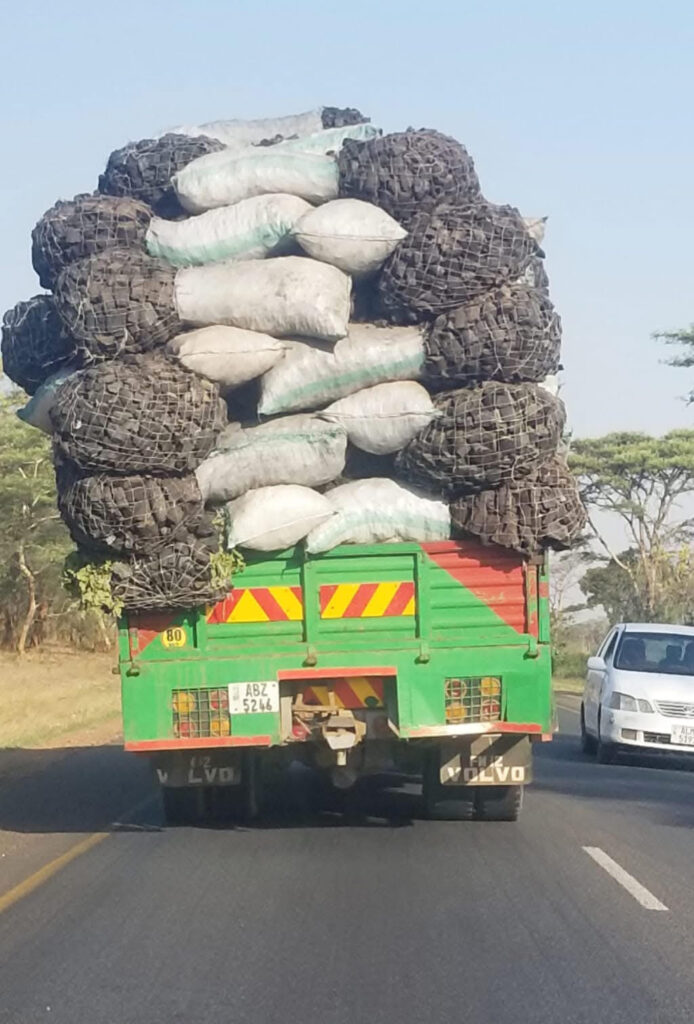
A truck loaded with bags of charcoal drives along Mumbwa Road in the Mwembeshi area. Picture by CHUSA SICHONE.

In February 2025, Habwaya left school in Grade Six. With his father unemployed and his mother trading vegetables occasionally, the burden of survival now rests on his young shoulders. Together with his uncle, he produces about 90 bags of charcoal from each kiln every four months.

“I know it’s wrong, but what should we do? We want to go back to school if the government can help us,” he says.

While children like Habwaya produce charcoal in rural Monze, traders and transporters move it freely to urban markets such as Lusaka and Mazabuka. Local authorities acknowledge that some transporters operate with forged permits or pay informal fees at roadblocks, a practice that allows the trade to thrive in plain sight.

Sixteen-year-old Alice Mweemba* dropped out of school in Grade Seven.

“There’s nothing to trade here except charcoal,” she says softly. “We would rather burn charcoal than starve.”

When asked about her future, she laughs nervously before murmuring, “Maybe one day I will go back to school.”

At Chona Primary School, head teacher O’Neill Kanene says absenteeism has reached 20 percent this year.

“Some learners walk up to seven kilometres to school every day,” he explains. “Others stay home to help their parents earn a living through charcoal burning.”

Community forestry officer Stanley Hamiyanda has witnessed the crisis unfold first-hand. Covering 13 villages with only a bicycle and ten volunteers, he conducts sensitisation campaigns on the dangers of deforestation and child labour.

“We find boys as young as 10 cutting trees or packing charcoal. During the school term, most children attend only 30 days out of 90,” he says.

His team confiscates charcoal and urges parents to send their children back to school, but within days, the same children return to the forest.

“People have no alternative,” he says. “Water bodies are drying. Farming is nearly impossible.”

In response, Forestry Department acting director Dr Fredd Siangulube says the use of children in illegal charcoal production is a serious concern that must be addressed with humility and firm protection measures. He notes that the charcoal licencing system is designed to prevent child participation, but enforcement challenges persist in districts like Monze, where limited transport hampers effective monitoring.

He said the department has received multiple reports of rampant illegal charcoal burning in the area and is prioritising strengthening its capacity. To improve the response, Monze and other districts will soon receive mobility support.

Dr Siangulube said 10 motorbikes and four new vehicles will be deployed by the end of the year to districts with the greatest need, a move he says will enhance monitoring of child labour and illegal charcoal burning.

Each day, trucks loaded with charcoal rumble out of Chona. For many families, every bag means another meal, and another tree lost.

According to the Ministry of Labour and Social Security, charcoal production is classified among the worst forms of child labour due to its health and safety risks.

Ministry spokesperson Mwaka Ndawa says the law clearly prohibits children from engaging in hazardous work such as charcoal production, as outlined in the Employment Code Act of 2019, Statutory Instrument No. 121 of 2013, and the Children’s Code Act of 2022.

Labour inspections and district-level child labour committees are meant to enforce compliance, but enforcement remains weak. The Ministry admits it has no data on children withdrawn from child labour in Monze, even as dozens continue to work openly.

In Chona, legality means little when hunger strikes. According to Global Forest Watch, Monze District had about 86,900 hectares of forest in 2020. By 2024, 248 hectares had already been lost, releasing an estimated 73,000 tonnes of carbon dioxide into the atmosphere. Each year, the district produces roughly 903,000 bags of charcoal, with studies indicating that about 65 percent of the charcoal consumed in Lusaka comes from freshly cleared woodlands rather than agricultural waste.

Communities are urged to prune rather than fell trees, but few comply.

“I only cut branches, not whole trees. I make fewer bags, but at least trees survive,” says charcoal burner Fanwell Michelo.

Forestry officer Stanley Hamiyanda notes that many avoid headmen promoting sustainable methods, choosing instead to cut trees in secret. With no real alternatives, the trade continues unchecked.

Despite clear laws and community awareness, there is little political will to act. Local councils rarely prioritise environmental enforcement, while national authorities focus more on energy shortages than on the human cost of charcoal production. The gap between policy and practice remains wide, and children like Mweemba are caught in it.

She dreams of becoming a nurse one day, but she is unsure that dream will ever come true. Until Chona finds real alternatives, children will keep leaving school, and the forests will keep disappearing.

Community members are urging the government to provide livelihood options such as tailoring, carpentry, and farming support, along with better access to CDF opportunities and water restoration projects. Above all, they want their children back in school.

Evidence from Chona shows that children remain deeply involved in charcoal production despite legal protections. Poverty, drought, and limited economic opportunities continue to drive the practice, while weak enforcement allows it to flourish.

Unless stronger interventions are made, including skills training, improved water supply, and tougher law enforcement, both the forests and the futures of Chona’s children will remain at risk.

Emily is a fellow under the Wildlife Crime Prevention (WCP) fellowship for journalists. The MakanDay Centre for Investigative Journalism, in partnership with WCP, provided training in investigative journalism skills and supported journalists in working on impactful stories that promote environmental protection and drive change.

How Poverty is Fueling Child Labour in Monze’s Charcoal Trade By Emily Kuwema Before sunrise, 14-year-old Alfred Habwaya* disappears into the thinning woodland of Chona Chiefdom in Monze district. His school uniform lies folded in an old bag, replaced by a sack and a machete. Each morning, he joins older men and women in feeding Latest News – MAKANDAY 

How Poverty is Fueling Child Labour in Monze’s Charcoal Trade By Emily Kuwema Before sunrise, 14-year-old Alfred Habwaya* disappears into the thinning woodland of Chona Chiefdom in Monze district. His school uniform lies folded in an old bag, replaced by a sack and a machete. Each morning, he joins older men and women in feeding

Illegal appointment of Phalala fund admin exposed  Inhlase on November 28, 2025 at 8:43 am

Ministry of health admits it was unfair labour practice, commits another illegal appointment in bid to hide it …Court declares similar appointment void.

By Zwelethu Dlamini

The Ministry of Health quietly installed a new administrator to run the Phalala Fund through a process that violated mandatory hiring laws and bypassed every safeguard meant to protect the integrity of public appointments.

Internal correspondence and records reviewed by Inhlase show that the Ministry filled the post without advertising the vacancy, interviewing candidates, or involving the Civil Service Commission’s Promotions Board — steps required under Regulation 28 of the Civil Service Order, 1973.

The Phalala Medical Referral Fund is an Eswatini government programme that assists citizens with accessing specialist medical care. The Fund handles tens of millions in taxpayer money and determines whether critically ill emaSwati receive treatment locally or abroad.

The appointment, made in January 2025, came just weeks after the legal acting term of long-serving Nursing Sister Cynthia Maseko expired. Maseko was appointed Acting Administrator of the Fund in June 2024—her second time performing the role, after first acting in 2021 when a previous administrator left.

Her acting term was legally limited to six months, expiring in December 2024, after which the vacancy was supposed to be advertised and opened to competition under Regulation 28 of the Civil Service Order, 1973. Instead, the Ministry of Health secretly appointed a new administrator, Simangele Dlamini, through a process that the Ministry itself later conceded constituted an “unfair labour practice” and exceeded the lawful six-month limit for acting appointments.

Maseko—who had previously acted in 2021 and again from June to December 2024—was bypassed without explanation, despite her institutional memory and operational experience.

On 4 February 2025, after recognising that the Ministry’s actions breached mandatory recruitment procedures, Maseko instructed her lawyers to write to the Civil Service Commission (CSC) demanding that the appointment be reversed and the post advertised in accordance with the law. The pressure prompted a remarkable admission. On 28 March 2025, Acting Principal Secretary Ncamsile Mtshali issued a written response acknowledging that the Ministry had exceeded the six-month acting limit and that the appointment process constituted an unfair labour practice. 

Instead of reversing the appointment, the Ministry attempted to neutralise the complaint by offering Maseko a Matron I post—a second appointment made without advertisement, interviews or competition. Officers who had been expecting the Matron I post to be opened were illegally superseded, revealing a repeated pattern of rule-breaking.

These unlawful appointments unfolded while the Phalala Fund was experiencing an unprecedented operational and financial breakdown. According to the Ministry of Health 2024/2025 Annual Report  the total budget of E179 928 740.00 was allocated for this Financial Year 2024/25, and a full release of the budget was done during the second quarter of the financial year. 

As of 31 December 2024, the amount owed to suppliers and service providers was E127 907 068.46. Phalala Fund owed E52 774 716.11 to service providers. The report states that contracts with foreign hospitals and specialist service providers expired on 31 March 2024. Although most were eventually renewed to 31 March 2025, several were not renewed in time, resulting in an immediate halt in patient referrals for specialist medical services and creating a significant backlog. Only after the contracts were reviewed and signed were some services restored.

The annual report further shows that referrals only resumed once the year’s budget was released. Debt had severely restricted the Fund’s ability to send patients out, as some service providers demanded that outstanding amounts be cleared before accepting new referrals. This interruption created a bottleneck of desperate patients. During the reporting period, 1,034 patients were referred, of whom 625 were sent for radiology. The remaining 409 were referred for specialist services, including oncology (116 patients), orthopaedics (44), ophthalmology (40), general surgery (32) and urology (27). 

“Over E50 million+ worth of invoices for past financial years will not be processed for payment due to shortage of funds of which most are local service providers. The current budget is not able to pay all arrears for previous financial years. Please note that Phalala also does not have a budget for the current year services since we used most in clearing our debts,” reads the report. 

According to the Ministry of Health, over 200 patients were waiting for assistance from the Phalala Fund as of July 2025.

Inhlase sought the required documents—PSC Form 4, written recommendations, interview minutes and Promotions Board records—but the Ministry of Health declined to comment, saying it could not discuss internal processes with a publication. The Ministry of Public Service also refused to respond directly, citing CSC’s constitutional independence under Sections 176 and 178 of the Constitution, and referred all questions to the Commission. 

The CSC Executive Secretary Nhlanhla Mnisi did not respond at all. The legal implications of these actions became more profound after the Industrial Court of Appeal delivered its ruling in Nkambule and Others v Chairman of the Civil Service Commission and Others (Judgment No. SZICA 41/2025, delivered 22 October 2025).The Court set aside a government promotion for violating the same legal requirements breached in the Phalala case: failure to advertise the post, failure to interview candidates, failure to provide written justification for superseding senior officers and unlawful delegation of authority by the Head of Department. The Court held that promotions made without complying with Regulation 28(1) and (2) and General Order A170 are ultra vires, unlawful and voidable.

Every procedural failure condemned in the Nkambule judgment occurred in the Phalala Fund appointments between June 2024 and March 2025. The Ministry exceeded acting limits, made a secret appointment, bypassed competition, concealed qualification requirements and repeated the same violations with the Matron I offer. The CSC provided no oversight. The Ministry of Public Service deflected responsibility. Three institutions with legal duties to uphold the recruitment framework instead retreated into silence.

These illegalities compromised a fund responsible for life-saving medical decisions. At a time when over 200 patients awaited assistance, when hospitals abroad were refusing emaSwati due to unpaid bills and when confidence in the health system was collapsing, the Ministry chose to install leadership through a process that violated the law and undermined public trust. The Nkambule ruling now provides a definitive legal basis to challenge the appointment and demand accountability for actions that harmed institutional integrity and denied patients timely. 

One senior official, speaking on condition of anonymity, warned that an inexperienced administrator—particularly one without a health background—might believe they were performing well simply because the Fund appeared to be operating “within budget.” 

“The Fund’s allocation is always lower than the medical demand…. What looks like a saving on paper usually means people who needed treatment were denied care,” the official explained. The official added that someone unfamiliar with clinical services may also fail to detect when the government is being overcharged for specialised medical procedures, leaving the Fund vulnerable to inflated billing.

More about the Phalala Fund

The Civil Servants Medical Referral Scheme established in 1995 covers costs of medical referrals to South Africa and Maputo for Civil Servants and their dependents, for specialist care that is not available in Eswatini. In 2002, this service was expanded with the establishment of the Phalala Fund, which provides access to specialised medical care to all eligible Eswatini nationals who are not already covered by another medical scheme. Together, the referral schemes aim to provide health coverage to emaSwati who are in need of specialized services, upon determination by the Phalala Board at Mbabane Government Hospital that options for treatment within the country  have been exhausted. The Phalala Fund covers costs of treatment, medications, accommodation, and transport for patients who are referred to external service providers. Phalala has continued to refer patients in need of specialized healthcare services from Government specialists to private specialist providers within Eswatini and externally to Mozambique and South Africa.

​Inhlase  

…Ministry of health admits it was unfair labour practice, commits another illegal appointment in bid to hide it …Court declares similar appointment void. By Zwelethu Dlamini The Ministry of Health quietly installed a new administrator to run the Phalala Fund through a process that violated mandatory hiring laws and bypassed every safeguard meant to protect the

Toxic Injustice: “They Forced Us Out and Fenced the Land” — Inside the Luela Stream Disaster Editor on November 28, 2025 at 7:42 am

By Linda Soko Tembo

In March this year, authorities found Rongxing, a Chinese-owned mining company, guilty of failing to prevent an acid leak into the Luela stream — a tributary of the Kafue River, one of Zambia’s major water sources. The leak, which followed a tailings dam failure, affected more than 200 farmers. Yet for the families who depend on the stream, the government’s action brought little comfort.

Before the pollution disaster, the Luela farming block in Kalulushi District was a vibrant agricultural zone, sustaining households through vegetable and crop production. The area sits in the same district where another Chinese-owned company, Sino Metals, caused a separate environmental disaster, raising concerns about a pattern of regulatory failures on the Copperbelt.

Farmers say the land that fed them for generations is slowly dying, poisoned by pollution from Rongxing’s processing plant in Sabina along Mufulira Road.

Today, stunted crops, barren fields, and rising health fears tell the story of a community pushed to the brink — yet meaningful action to stop the contamination remains absent.

A farming community in decline

A MakanDay investigation found that since Rongxing began operations in 2017, more than 50 farmers lost their land to the company without adequate compensation. Farmers who retained some land say their fields were later contaminated by acidic waste, leaving the soil infertile.

They say land that once produced maize, carrots and sugarcane now resembles a wasteland. Although lime was later applied to neutralise the pollution, farmers report that it has made little difference.

“Farming is our life, but now the land is slowly dying, and the same polluted water is what traders use to wash the carrots, cabbage, rape, tomatoes, and other crops they buy from us,” said one farmer, who requested anonymity.

Another insider familiar with environmental operations in the area said the company had been polluting the Luela stream for years.

According to the source, pollution incidents, whether in water, dust, or air — are often dismissed as falling within “acceptable limits”.

Residents now question whether water quality in the stream is independently monitored, and whether any oversight exists beyond paperwork

A project that grew beyond its promises

The source further revealed that Rongxing initially acquired a small plot of about five acres, roughly the size of three football pitches, from a local couple. He alleges that during the Environmental Impact Assessment (EIA), the company assured the community it would not expand nor pollute the stream or surrounding environment.

However, the company has since expanded aggressively, with minimal regulatory restraint.

“From a layman’s perspective, the location is questionable. The distance between the rail line and the stream is too narrow for industrial activity,” the source said.

Initially registered as a small-scale operation, Rongxing reportedly obtained multiple Environmental Project Briefs (EPBs), allowing it to enlarge its operations beyond its original approval.

Farmers allege that since 2020, the company has offered compensation each time the stream is polluted, a cycle they describe as inadequate, inconsistent and unethical.

A ZEMA media statement dated 16 October 2020 shows that the ridge of the tailings dam at the Rongxin Investments plant collapsed on 15 October, resulting in an abnormal discharge of slurry effluent into the Luela Stream.

Preliminary investigations by ZEMA inspectors confirmed that large volumes of tailings had entered the waterway. As an immediate enforcement action, the agency ordered the company to suspend operations, undertake clean-up and restoration works along the affected stretch of the stream, and submit a detailed remediation plan.

“They forced us out and fenced the land”

One of the affected farmers, Febby Chewe, said that after acid destroyed her field, the company took over the land entirely.

“We used the stream to irrigate our gardens. After the pollution incident, they forced us out and fenced the land. They only gave me K3,000 while other farmers were given 2000,7000, 1000 among others. I used to make K3000 every week from farming,” she said.

Chewe added that even aquatic life has vanished from the stream.

Another farmer, Ian Kapongolo, a father of nine, expressed similar disappointment.

“Farming is my life. That is how I raised my family. After our fields were destroyed, they gave me K3,000. Even people in offices respected the income we used to make. But now we are suffering,” he said.

Farmers say they expected higher compensation after Copperbelt Minister Elisha Matambo announced that payouts would range from K100,000 and above, depending on the size of land affected.

Kapongolo questioned how such low figures were approved, asking: “Can the government honestly approve that people be given just such kind of compensations?”

Government response and ongoing negotiations

Kalulushi District Commissioner Joseph Phiri attributed the variations in compensation amounts to differences in land size.

“Compensation depended on the hectares each person was cultivating. Government officers conducted ground assessments and the company paid according to the committee’s report,” he said.

Phiri added that, in his view, the matter has been resolved.

However, Malisa and Partners Legal Practitioners, who represent some of the 118 affected residents — say there is no court case yet because discussions with both the company and the government are still ongoing.

Lawyer Mehluli Malisa Batakathi said many affected individuals feel excluded from the compensation process.

 “Most of the time, compensation packages are imposed on them. They are simply given money and asked to sign,” he said.

The company’s defence

A source within Rongxing said the company followed all required environmental procedures before beginning operations in 2017. He confirmed that heavy rains in December last year caused an overflow from one of the dams, resulting in waste entering the stream.

“ZEMA inspected the site and advised us on remedial measures. We immediately applied lime and cleaned up the spill,” he said.

The source also claimed that members of the community had been stealing materials from the dam infrastructure, which weakened the structure and contributed to the overflow. He added that misinformation circulating in the area had further fuelled tensions between the company and residents.

“In March, the Minister of Water Development and Sanitation, Hon. Collins Nzovu, visited the site as part of his inspections following the Sino Metals incident. He had previously visited our company and given recommendations. During his visit, he inspected the dams, including the section where the breach had occurred, and observed traces of the earlier spill,” the source said.

According to the source, the Ministry of Agriculture and other government departments assessed the affected fields and presented a compensation bill of over K2 million, which the company paid.

Rongxing Mineral Processing Plant representative Destiny Xiao declined to comment further, saying only that the company had complied with the government’s directive to compensate affected farmers. She also warned the reporter that legal action would be taken if what she described as “correct information” was not published.

A community still waiting for justice

Despite the company insisting it has met its obligations, farmers say their land remains poisoned, their income wiped out, and the Luela stream, once the lifeline of the community, now flows with uncertainty.

For many families, the spill did not just destroy crops; it destroyed their future. And while authorities insist the matter is resolved, residents say the soil tells a different story.

By Linda Soko Tembo In March this year, authorities found Rongxing, a Chinese-owned mining company, guilty of failing to prevent an acid leak into the Luela stream — a tributary of the Kafue River, one of Zambia’s major water sources. The leak, which followed a tailings dam failure, affected more than 200 farmers. Yet for Latest News – MAKANDAY 

By Linda Soko Tembo In March this year, authorities found Rongxing, a Chinese-owned mining company, guilty of failing to prevent an acid leak into the Luela stream — a tributary of the Kafue River, one of Zambia’s major water sources. The leak, which followed a tailings dam failure, affected more than 200 farmers. Yet for

Tempers flare as floods ravage homes Editor on November 26, 2025 at 1:38 pm

By Gift Ngandu

Tempers are running high among residents of Mazabuka’s Kabobola and Zambia townships as floodwaters ravage residents’ living rooms and bedrooms.

Reconstruction work on a bridge designed to ease mobility and mitigate the flow of water was earmarked for completion before the start of current rains.

However, work on the bridge has stalled leading to it being washed away during recent downpours, with residents heaping blame on the contractor, Asphalt Roads Zambia (ARZ).

Collins Maila, a senior official of the governing United Party for National Development (UPND) in Mazabuka district has meanwhile questioned the proactiveness of civic leaders following recent heavy downpours that left several households flooded and damaged.

Maila expressed concern that the contractor working on township roads in the affected areas had enough time to address the long-standing drainage challenges but had made little progress.

He said the failure to act earlier resulted in floodwaters destroying household property following the recent torrential rainfall.

He urged district leaders to act swiftly and ensure that the contractor

implements corrective measures to protect residents from recurring disaster.

While residents grappled with damage to property, district authorities moved quickly in to address the situation.

Mazabuka municipal council assistant public relations manager Caroline Simumba announced that the council has engaged ARZ to discuss the growing concerns.

A high-level meeting was held on 21st November 2025, chaired by mayor Vincent Lilanda and attended by the town clerk, ward councillors, the road consultant, and ARZ representatives.

Discussions centred on worsening flooding in areas such as Mazabuka Girls Road, Chachacha

Road, and Zambia Compound – problems attributed to ongoing road construction works.

The meeting concluded with several key resolutions aimed at mitigating further damage.

A major directive requires ARZ to suspend any new works and instead channel efforts toward correcting challenges in areas already under construction.

The contractor also agreed to urgently repair damaged roads, a responsibility provided for within the contract.

“Today’s meeting underscores our commitment to safeguard our residents and improve infrastructure resilience,” said Mayor Lilanda.

“We recognize the urgency of addressing these flooding concerns and are taking proactive steps to ensure the safety and well-being of our community.”

He further clarified that the road project is a central government initiative, with the Mazabuka municipal council serving as a third-party overseer.

The council has since submitted its observations and recommendations to the relevant authorities.

In response to the suffering experienced by families affected by the floods, Mazabuka Central member of parliament Garry Nkombo, delivered relief aid to Zambia Compound and Airstrip on 22nd November.

The donation, made through the Garry Nkombo Foundation, included 25 kg bags of mealie meal, 29 blankets, and K3,400 in cash to help affected households

recover.

Nkombo said that the Disaster Management and Mitigation Unit (DMMU) would soon assess the affected areas and offer further support.

One of the affected residents, Brenda Mwanza of Airstrip Compound, expressed gratitude for the relief given but appealed for additional help, particularly funds to replace household items lost in the floods.

“We are grateful to our MP for the support but this is not enough. We also need more money and other food stuffs as they were washed away in the floods. We are calling on well-wishers to help us”she said.

As the rainy season intensifies, residents remain hopeful that the measures taken by civic leaders and contractors will prevent further destruction and enhance safety in the most vulnerable areas of Mazabuka.Produced by Mazabuka FM reporters, this story was edited and fact-checked by Makanday as part of an investigative training collaboration with Maz FM.

By Gift Ngandu Tempers are running high among residents of Mazabuka’s Kabobola and Zambia townships as floodwaters ravage residents’ living rooms and bedrooms. Reconstruction work on a bridge designed to ease mobility and mitigate the flow of water was earmarked for completion before the start of current rains. However, work on the bridge has stalled Latest News – MAKANDAY 

By Gift Ngandu Tempers are running high among residents of Mazabuka’s Kabobola and Zambia townships as floodwaters ravage residents’ living rooms and bedrooms. Reconstruction work on a bridge designed to ease mobility and mitigate the flow of water was earmarked for completion before the start of current rains. However, work on the bridge has stalled